


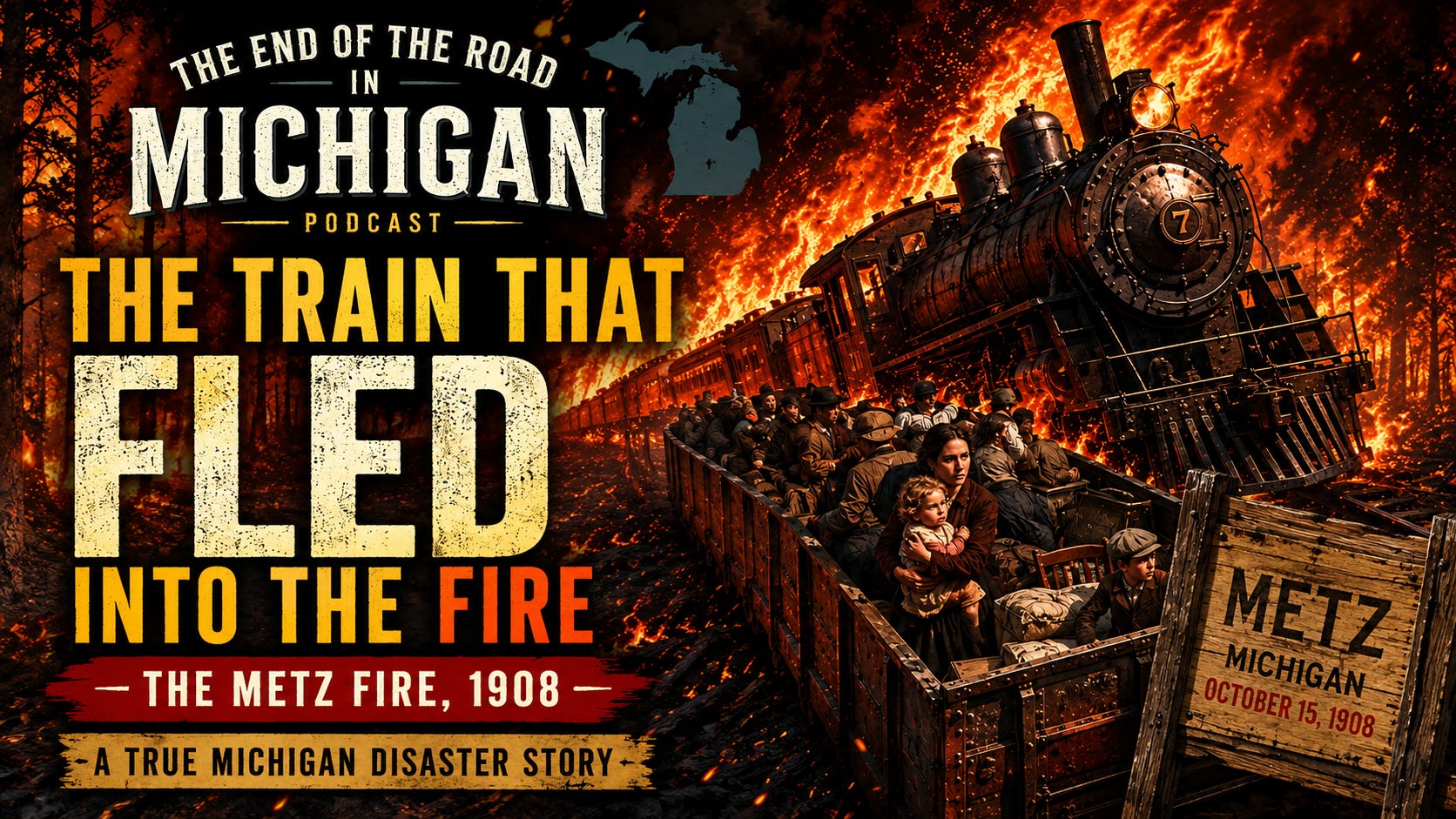
On Oct. 15, 1908, families crowded into freight cars at Metz, Michigan, believing the railroad offered their best chance to escape a fast-moving forest fire.
The train did not carry them away from the flames.
It carried them into them.
That doomed evacuation is the focus of a new episode of The End of the Road in Michigan: “The Train That Fled Into the Fire: The Metz Fire of 1908.”
The episode revisits one of northern Michigan’s most disturbing disasters through the people who boarded the train, the crew members who pushed forward and the families who faced impossible choices as fire swept across Presque Isle County.
A Village Built Around the Railroad
Metz was a small farming and railroad community southwest of Rogers City. Its residents depended on agriculture, timber and the Detroit & Mackinac Railway.
The railroad brought passengers, mail, equipment and supplies. It also carried lumber, cedar posts, railroad ties and hemlock bark from the surrounding country.
Those materials helped support the local economy. During the Metz Fire, they became fuel.
Northern Michigan had endured months of dry weather. Logging had left branches, bark, stumps and other debris across the cutover ground. Farms were surrounded by dry vegetation, wooden fences, barns and wood-frame homes.
When fire began west of Millersburg, high winds drove it across the region. Metz, South Rogers, Bolton, Cathro and nearby rural settlements were caught in its path. The fire killed 37 people and left hundreds without homes.
The Relief Train Arrives
As smoke closed around Metz, residents turned to the railroad.
A Detroit & Mackinac Railway train was sent to evacuate the village. It was not a conventional passenger train. Families climbed into boxcars and open freight gondolas, bringing children, blankets, trunks and whatever property they could load quickly.
Most believed they were making the sensible choice.
The locomotive headed away from Metz toward what the passengers hoped would be safer ground. Instead, it approached Nowicki’s Siding, where piles of cedar posts, railroad ties and bark were already burning.
Flames stood on both sides of the track.
The engineer faced a decision with no safe answer. Stopping would leave the train surrounded by fire. Turning around was not possible. The crew pushed ahead.
Heat had damaged the railroad bed and twisted the rails.
The locomotive derailed.
A Steel Car Became a Furnace
The open gondola carrying women and children stopped inside the burning corridor.
People climbed or jumped over the sides. Some crawled through smoke until they reached fields or ditches. Parents tried to hold children while embers landed around them. Others became separated in the confusion.
Historical accounts differ on the precise number killed at the wreck, but women and young children made up most of the victims. The wider Metz Fire killed 37 people and left about 700 residents homeless.
The tragedy carries a bitter contradiction.
The railroad had helped Metz grow. It connected the village with Alpena, Rogers City and markets farther south. When disaster came, residents trusted that same railroad to carry them out.
Instead, the train entered a section of track bordered by the products that had built the regional economy.
Timber, bark, ties and cedar posts became the walls of a furnace.
Rogers City and the Wider Fire District
The Metz Fire was not an isolated village disaster. It formed part of a regional emergency that threatened communities across northeastern Lower Michigan.
Rogers City was already developing as an important Lake Huron settlement tied to lumber, shipping and stone. Its location near Metz placed the community close to the fire district and the relief effort that followed.
The history of Rogers City reflects many of the same forces that shaped Metz: forests, railroads, immigrant labor, industry and access to Lake Huron. The city later became closely identified with limestone mining and the enormous Calcite quarry, but its early years were rooted in the same northern Michigan economy that left many communities vulnerable to fire.
That regional connection matters. Metz did not burn in a vacuum. The fire affected farms, rail lines, villages and families throughout Presque Isle County.
Listen, Then Read More
The new podcast episode places listeners aboard the relief train as it leaves Metz and moves toward the burning siding. It also follows survivors after the derailment and examines what happened when residents returned to a village reduced to ashes.
For a fuller account, photographs and historical background, read:
History of the 1908 Metz Fire — The Shocking Day a Railroad Village Burned
To learn more about the nearby Lake Huron community and its rise from logging settlement to major industrial center, read:
History of Rogers City, Michigan — From Logging Camps to the World’s Largest Quarry
The story of the Metz train remains powerful because its passengers were not reckless adventurers. They were parents, children and neighbors making a hurried decision under conditions they could barely understand.
They boarded because the train looked like a way out.
By the time they reached Nowicki’s Siding, the road ahead was already burning.


