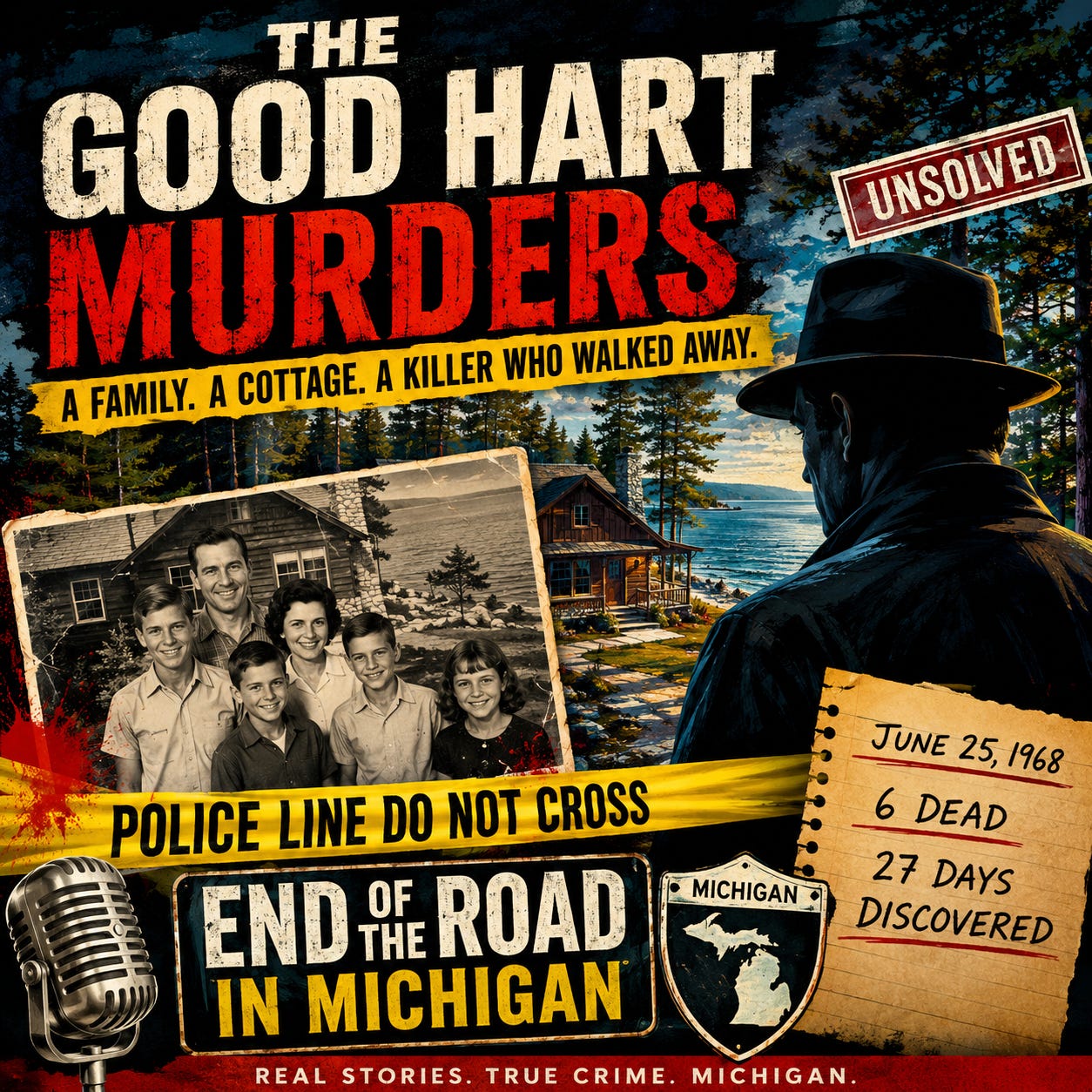
For 27 days, the cottage stood silent.
It sat near Lake Michigan, surrounded by woods north of Good Hart. Mail accumulated. Telephone calls went unanswered. Friends and business associates assumed the Robison family was still enjoying its summer vacation.
Then a caretaker noticed the odor.
On July 22, 1968, he entered the locked cottage known as Summerset and found all six members of the family dead.
Richard Robison, 42; his wife, Shirley, 40; and their four children — Richie, 19; Gary, 16; Randy, 12; and Susan, 8 — had been murdered.
The delay damaged evidence, clouded the timeline and gave the killer nearly four weeks to disappear.
The Good Hart murders became one of northern Michigan’s most notorious criminal cases. No one was ever convicted, but several investigators later said they believed they knew who committed the crime.
A family comes north
The Robisons lived in Lathrup Village, near Detroit. Richard operated advertising and publishing businesses, and the family spent summers at Summerset, a secluded log cottage near the Lake Michigan shoreline.
The setting offered peace and privacy. It also allowed someone familiar with the property to approach without attracting much attention.
Police believed the family was killed on June 25, 1968. Investigators concluded that the attacker used several firearms, including a .22-caliber rifle and .25-caliber pistols.
The victims were found in different areas of the cottage, suggesting the attack unfolded quickly. The killer then closed the house, concealed some of the damage and left.
No alarm reached police.
Twenty-seven lost days
The long delay before the bodies were found shaped the investigation.
Summer heat and decomposition damaged the scene. Insects affected the remains. Witnesses were asked to remember noises, vehicles and unusual activity from nearly a month earlier.
Police were also working before DNA testing, digital records and modern crime-scene procedures.
Investigators reviewed hundreds of tips and examined business associates, local residents, known criminals and people connected to other Michigan murder cases.
One name kept returning to the center of the investigation.
The prime suspect
Joseph Raymond Scolaro III worked for Richard Robison and helped manage his Detroit-area business while the family was in northern Michigan.
He knew the family.
He knew where the cottage was located.
He also knew the company’s finances.
Investigators believed money had been disappearing from Robison’s businesses. On the morning of June 25, Richard reportedly learned that funds were missing and angrily demanded to speak with Scolaro.
Scolaro left the office around 10:30 a.m. Investigators said he could not fully account for his movements until late that night.
That gave him enough time to drive to Good Hart and return to the Detroit area.
The gap did not prove murder, but it gave police motive and opportunity.
Firearms evidence also drew attention. Investigators connected Scolaro to weapons or ammunition similar to those used in the killings. He claimed that he had transferred one pistol and ammunition to Richard.
That explanation created a problem. A weapon connected to a suspect can support guilt, but it can also support an innocent account when the suspect says the victim possessed it.
The murder weapons were never conclusively recovered.
There was no eyewitness.
No fingerprint placed Scolaro inside the cottage during the killings.
The case remained circumstantial.
Why prosecutors hesitated
Investigators believed the evidence formed a clear pattern:
Missing business funds
Richard’s angry telephone call
Scolaro’s unexplained absence
His knowledge of the cottage
Connections to firearms and ammunition
Emmet County prosecutors still declined to charge him.
Police officers can believe they have solved a case. Prosecutors must decide whether they can prove guilt beyond a reasonable doubt.
A failed trial could have ended in an acquittal. Under double-jeopardy protections, Scolaro could not have been tried again for the same murders.
Investigators who believed the case was strong enough were frustrated. They thought the evidence should have been placed before a jury.
That never happened.
A second attempt ends
By 1973, prosecutors were again reviewing the possibility of charging Scolaro.
Before the case could move forward, he died by suicide.
He left notes denying that he had killed the Robison family.
His death ended the clearest path to a trial. It also left a lasting argument.
Some investigators viewed the suicide as the act of a suspect who feared arrest. Others noted that suicide is not a confession and may have many causes.
No jury reviewed the evidence.
No defense attorney challenged the state’s theory.
No prosecutor questioned Scolaro in open court.
Solved or unsolved?
The Good Hart murders remain legally unsolved because no one was convicted.
Yet retired investigators and prosecutors have publicly said they believe Scolaro was responsible. At a 2018 forum in Petoskey, several people who had reviewed the case identified him as the killer.
That is not the same as a legal finding.
The evidence may point strongly toward Scolaro, but history must stop where proof stops.
Northern Michigan journalist Mardi Link later reviewed police files, records and interviews for her book, When Evil Came to Good Hart. Her work returned attention to the evidence and to the Robison family.
The cottage was eventually demolished. The physical crime scene disappeared, but the unanswered questions remained.
Richard, Shirley, Richie, Gary, Randy and Susan had traveled north for a Michigan summer.
They never returned home.
The Good Hart case has no courtroom ending. There was no arrest, verdict or sentence.
Instead, it ends with a suspect who denied everything and died before the evidence could be tested.
The case may have been solved in the minds of investigators.
It was never solved in court.
Listen to the podcast
The latest episode of End of the Road in Michigan follows the Robison family’s final summer, the discovery at Summerset and the case investigators built against Joseph Scolaro.
🎧 The Good Hart Murders: A Family, a Cottage and a Killer Who Walked Away